My next blog:
Developing the middle layer.
In this post, I explore the next phase of leadership development — moving from consistency to capacity. Once whole-school systems and expectations are established, the real challenge is empowering middle leaders to sustain and extend that consistency across their own teams.
-

In school leadership, it’s easy to confuse rigour with relentlessness.
We assume being rigorous means increasing intensity, driving harder, pushing faster, and adding more layers to what we already do. Yes this can, under some circumstances drive rapid improvement but in my experience, intensity burns people out. Consistency builds them upTrue rigour looks different. It isn’t about doing more, it’s about doing what matters consistently well and repeating.
Throughout my leadership journey and particularly as a Principal leading schools through challenging circumstances, I’ve underpinned leadership behaviours with a shared language and a replicable, steady, sustainable rhythm of daily activity. This approach generates the rigour but embraces sustainability – leaving intensity for the moments when it is really needed.
At Cliff Park, we talk a lot about Everyday Excellence. Excellence is achieved through consistency and that repetition gives people confidence.
As that level of consistency flows through every layer of leadership, we have been able to harness a slow yet relentless momentum for school improvement.
That’s really the heart of leadership rigour – repeated consistency in every interaction and intensity in bursts when required.

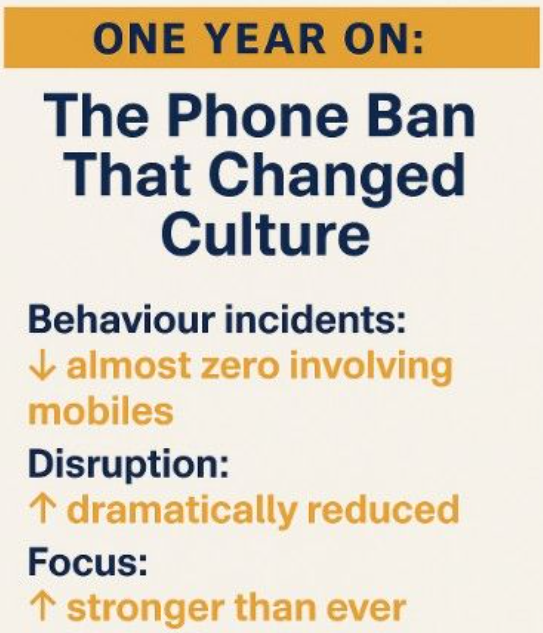
One year ago, we took a bold step at Cliff Park Ormiston Academy: a genuine mobile phone ban. It wasn’t easy, but the impact has been transformative on behaviour, focus, and school culture. Here’s what we’ve learnt, and why we’re proud to be part of a grassroots movement across Ormiston Academies Trust.
One Year On: How Removing Phones Created Space to Transform Our Culture
In October 2024, we made the decision to implement a genuine mobile phone ban at Cliff Park Ormiston Academy. This wasn’t a tokenistic step. It was a strategic decision, rooted in research, behaviour data, and our own experiences. Our goal was clear: to ensure that every student could learn in an environment free from unnecessary distraction.
Why did we take this step? Whilst our self-evaluation had already highlighted positive improvements, mobile phones continued to drive low-level disruption and truancy. Behaviour logs showed that phones almost always contributed to conflict and bullying. The capacity drain on staff was significant and was blunting our pastoral support.
Our experience proved that partial restrictions or “away in bags” policies weren’t enough. To really shift culture, the policy had to be clear, consistent, and enforceable. That meant a complete ban on student use of mobile phones during the school day.
Since implementing the ban, our behaviour data tells a powerful story:
**Behaviour incidents** linked to mobile phones have reduced to almost zero. A distraction we once spent significant time managing has been removed altogether.
**Lesson conduct has improved** Teachers report smoother starts, fewer interruptions, and more sustained concentration from students.
**Social interactions are healthier** Break and lunch times are now filled with genuine conversation, play, and connection rather than screen-time withdrawal.
**Consistency is stronger** Staff no longer have to negotiate grey areas students and families understand the expectation clearly.
Student surveys show that young people notice the difference too. Many describe the ban as “fairer” because it applies to everyone equally, while others recognise how much more focused they feel in lessons.
As we look ahead we are committed to ensuring that every strategic decision we take is about removing barriers to learning and belonging. The mobile phone ban has been one of the most significant culture-shaping moves we have made as an academy.

 Reflections of a Head Teacher